Tag Archives: Travel

Cranbrook & More !

6 Oct

brook 149

I love this time of year; days are still warm, leaves are just beginning to change, evenings are getting cooler-hinting at what’s to come. Here in the Mitten it is harvest time, farmers markets are bursting at the seams with fresh produce; apples are plentiful this year. Today we are at the Birmingham Farmer’s Market, going on every Sunday from May to October, it takes place in Municipal Parking Lot #6 at the bottom of the hill on Old Woodward, each year it gets a little bigger. We are greeted by bunches of fresh-cut Zinnias, pots of Mums and music in the distance.  We meander down the aisles, baskets are overflowing with ripe red tomatoes, peppers in a rainbow of colors from red to purple, fancy skinned eggplant and potatoes in a variety of shapes and shades. The marketplace continues to the left, behinds the Woodward storefronts, prepared foods are readily available, the hot dogs smell delicious. Jars of local honey are stacked on a table, they glow in the sunlight, plastic containers are filled with popcorn kernels, artists display their wares. The back of the lot is wooded, picnic tables invite shoppers to indulge in breakfast, lunch, or just sit with a cup of coffee and enjoy the surrounding activities. Vendors are set up under rows of white canopy’s offering baked goods, artistic gourds and gardening advice. Pots of fall perennials are in bloom, tomatoes come in grape, pear and cherry varieties, bundles of Japanese Lanterns look ready for Halloween. With about 70 booths each Sunday seems to be a little different, the quality and selection will make you want to visit often. With only a few weeks left in the season, check it out soon! Time to go, our tour at Cranbrook begins soon.

brook 031brook 004

brook 013

brook 030

In 1887 George G Booth married Ellen Warren Scripps in Detroit; he was the publisher of the Evening News Association and later co-founder of Booth Newspapers, she was the daughter and later heiress to her father James E Scripps, founder of the Detroit News. The exceptionally wealthy couple lived in a magnificent home on Trumbull in Detroit-now the site of Scripps Park, in 1904 they purchased land in Bloomfield Hills and hired Albert Kahn (who else) to build them a summer home, it was called Cranbrook House. In 1908, after the death of James Scripps, the Booth’s made Cranbrook their full-time residence. In 1922 these most generous philanthropists (the Booth’s were also benefactors of the DIA) believed their estate should serve a public purpose, they called on Eliel Saarinen to help complete a master plan and the building of six new institutions began. Booth was an avid student of the Arts and Crafts movement, along with Saarinen he worked closely with sculptor Carl Milles; what they fostered is now a 319 acre campus consisting of the Brookside School for Children, Christ Church Cranbrook, Cranbrook School for Boys, Cranbrook Academy of Art, Cranbrook Institute of Science and the Kingswood School for Girls. The men worked together for decades designing, shaping, forging an enchanted center for learning, thinking and creating. This National Historic Landmark features the works of Eliel Saarinen, Albert Kahn, Steven Holl, Carl Milles, Marshall Fredericks, Peter Rose, Tod Willaims and Billie Tsien. A center of education, science and art, it serves students from Pre K to Graduate students, the Booths deeded their home, contents and surrounding property to the Cranbrook Foundation in 1944 and continued living on the premises until their deaths. Today we are doing a walking tour,The Cranbrook Vision: Architecture, Landscape and Sculpture.

brook 114

brook 129brook 051

brook 104

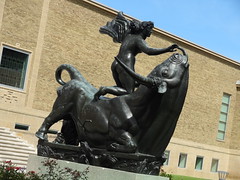
We meet our guide inside the Cranbrook Art Museum, designed by Eliel Saarinen and built in 1942 it is a wonderful example of Mid Century Modern architecture. It is only the two of us on the 1:00 tour, we begin just outside the museum; to one side is the well-known Orpheus Fountain completed in 1937 by Carl Milles, to the other the Triton Pools; a long pool made up of a series of three tiered basins designed by Saarinen and bronze Triton sculptures by Milles, the sight is breathtaking. The entire campus was designed on an axis, standing in this location our eyes are treated to panoramic views leading through arches, past sculptures ending at thoughtfully placed structures; every tree, every walkway was planned. Walking towards Lone Pine Rd we stop and gaze at the Triton Pools, the Nichols Gate (Saarinen 1941) parallels the narrow roadway, a delicate design in wrought iron flanked by Milles sitting boars.  Cranbrook is beautiful year-long but there’s something special about visiting in the fall, the students have moved in, the grounds are buzzing with activity, the scenery is outstanding. As we walk towards the dining hall we pass Milles Sunglitter sculpture and his Siren with Fishes fountain, I simply have to stop and look at each piece. We encounter walkways of patterned brick, walls with stone accent pieces, and arched passageways, all embellished with amazing detail, many with an Art Deco flair. It’s as if we’ve been transported to a different place and time, as close to Europe as you’re going to get in the Midwest.

brook 061

brook 091brook 089

brook 078brook 070

Our guide is filled with interesting stories and information, once we step inside the dining hall her voice falls on deaf ears as we take in this extraordinary room. Designed by Saarinen, the rectangular dining room looks like it’s straight out of Harry Potter; barrel-vaulted ceiling, long, narrow leaded glass windows allow sunlight to flood the room-no two are alike, original tables and chairs still serve the students well, the parquet floor gleams in this light. Indoor lighting consists of 2 rows of unique fixtures resembling inverted glass shades that dangle from long chains, they are elegant and again create a bit of an Art Deco feel, a large fireplace anchors one wall. Back outdoors we study the building, everything here is a work of art; doors, windows, brickwork, it seems we are never far from the sound of water splashing in a fountain or a marvelous Milles sculpture. Buildings and spaces were created by architects, artists and gardeners, creating areas of beauty, respite. We are now in the quadrangle, an expanse of green grass softens the hardscape, architectural elements include copper gutters, carved wood doors, bronze sculptures, archways and the Quadrangle fountain, it is all so picturesque.

brook 151

brook 152

brook 034

brook 038

Our walk leads us to the Williams Natatorium, built in 1999, designed by Tod Williams and Billie Tsien, this 20,000 sq ft building is spectacular. Housing an eight-lane swimming pool, it feels as if you are swimming outdoors; a deep blue ceiling opens to the elements through skylights, outside the large windows, trees and plantings give the impression of seclusion. The building received an award in 2001 from the AIA. Used for competitive and recreational swimming, it appears to be popular. Continuing through campus the pergola has recently been restored, great wrought iron pieces innocently attract our attention, a concrete column looks as if it is tufted,  we learn the school is still made up of 2 single-sex campuses. Back to the Art Museum, stopping inside we wander around the new Modernism exhibit, we are so in our element here. Great displays of furniture, textiles, photos, blue prints and renderings make us ohh and aahhh, in the very back a room is set up where you can actually sit in an Eames chair or at a Saarinen table, pretty cool! The permanent collection contains pieces by Charles and Ray Eames, Harry Bertoia and Maija Grotell. The Academy of Art, founded by the Booth’s in 1932, is one of the nations leading graduate schools of architecture, art and design, is also found in this building. George and Ellen’s desire to create a place of learning, meaning and beauty was the catalyst for Cranbrook, their dream lives on today.

brook 170

brook 167

brook 161

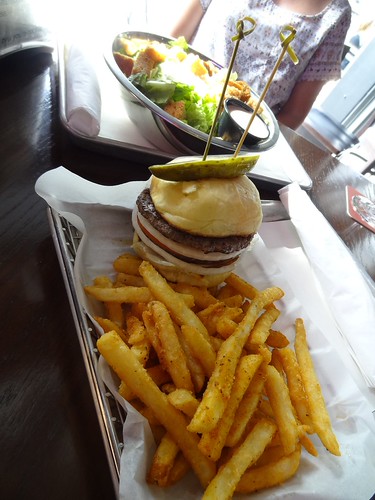
Lunch anyone? The Griffin Claw Brewing Company opened not long ago to great fanfare in Birmingham. Owned by one of the families who has ownership in Big Rock Chophouse just down S Eton St, it is one of the top 10 largest breweries in Michigan. It is another gorgeous day, the roll-up doors are fully opened, folks are evenly distributed throughout the patio, dining and bar area, the Lions are on TV. Taking a high-top table near the bar I first read over the beer menu, they have 12 beers on tap including seasonal and specialty beers. After a series of questions and answers with our server I choose the Bourbon Imperial Stout, Kris orders one of their sour beers with a splash of homemade raspberry syrup, yum. The casual menu features high quality ingredients in a selection of starters and local favorites. The 12,000 sq ft facility is dedicated mostly to the brewery, Dan Rogers is their world-class brewmaster and is no stranger to winning top awards for his creations. My beer is fantastic, luckily our food arrives before I finish it off. The Caesar salad is excellent, crisp lettuce, great dressing. The Claw Burger is made from chopped brisket, this one is a double decker, very flavorful and cooked just the way we like it, the seasoned fries are tasty too. My beer was outstanding, service was excellent, the food delicious, to top it off, the Lions won!

DETROIT: Cultural Center Tour

28 Sep

pd 010

Now and again we like to be ‘tourists’ in our own city; these days tours of Detroit can be taken daily, choices vary from walking and bicycle to segways and buses, today our feet will take us through Detroit’s Cultural Center. We begin our tour at the McKenzie House, a lovely 1895 Queen Ann style residence that is now Preservation Detroit’s (f.k.a. Preservation Wayne) headquarters. As Detroit’s largest and oldest historic preservation organization, members have worked tirelessly since 1975 to preserve, promote and protect the city’s rich architectural heritage. Over the years we have trekked through the streets of the city, gone inside private homes and seen amazing buildings on tours led by this all volunteer organization. We meet inside the house, a large group has gathered for this Saturday morning tour, we pay our $10 and head out the door, gathering on the Cass Ave sidewalk.

pd 003

113

pd 007pd 006

As we make our way over to Woodward, our guide Kathleen, shares interesting stories and histories of buildings we pass, her assistant Susan adds to the conversation. On Woodward we see large historic homes, reminding us that this once was a residential neighborhood, many are currently owned by Wayne State University and used for storage and administrative purposes. We pause in front of the Maccabees Building, built in 1927 for the fraternal organization Knights of the Maccabees, the elaborately carved limestone facade is incredible. The main entryway deserves a few moments of our time, we stop and study  intricate patterns and series of solemn knights that surround  the elongated arch, I see columns and faces, two knights stand atop the door frame, above them a fanciful clock is anchored to the building.

pd 009

pd 008

pd 012

Just down the street we enter the Detroit Public Library Main Branch, designed by Cass Gilbert in the Italian Renaissance style, it was built in 1921 of Vermont marble and serpentine Italian marble trim. If you have never been inside the library, you need to see it. To the right is the Children’s library, I love the fireplace. Mary Chase Perry Stratton created the tiles, large ones represent fairy tales, others shimmer in her signature luster glaze. We ascend a staircase, an ornate coffered ceiling comes into view. At the top of the stairs a barrel-vaulted ceiling is illuminated by lantern style lights hanging from a single chain. Adam Strom Hall is spectacular, a mural is painted in three sections, a man fills the center space, he holds the past in one hand and the present in the other, Kathleen has much to tell us in this room. We exit the building through the back, this is the 1963 addition to the building, do not miss the magnificent mosiac fascade.  

pd_026_(1)pd 030

pd_024_(1)

pd 045

The Detroit Historical Museum is our next stop, out front is Legends Plaza, a collection of hand prints set in concrete of men and women who have called Detroit home. As I listen I walk around placing my hands inside the hand prints of Al Kaline, Elmore Leonard, Lily Tomlin, Gordie Howe and Alice Cooper. Further up Woodward the George L Beecher House is being refurbished, this 3-story yellow brick and limestone home was designed by HJ Maxwell Grylls and built in 1894, one of the most outstanding features is the original Tiffany stained glass window on the east Ferry side of the home. Across the street stands the  Hecker-Smiley mansion, you have probably seen this castle-like structure as you have driven down Woodward. The once private home is marvelous, designed by Louis Kamper it is 20,988 sq ft of French Renaissance Chateauesque design, Kris and I have previously been inside, the interior is spectacular. Around the corner on Ferry Street is the former home of Charles Lang Freer, he was a Detroit industrialist with a passion for collecting art, at one time he purchased Whistler’s Peacock Room and had it installed in his home; it is now housed at The Smithsonian Institution in Washington DC.  Across the street a series of four restored Victorian homes and two carriage houses make up the Inn on Ferry, a lovely alternative to staying in a hotel when visiting the city. The East Ferry Avenue Historic District was originally part of the Ferry Seed Company, the neighborhood was developed in the late 1800’s into an upper-class neighborhood. The street is gorgeous, great architecture, mature trees and today, a flawless blue sky. 

pd 051

pd_054_(1)

pd 060

pd 073

The College for Creative Studies Ford Campus is located on Kirby, buildings represent many different time periods and architectural styles, large sculptures dot the campus. Further down Kirby we arrive at the Scarab Club, the brown brick building is rich in details, home to artists studios and galleries it’s a fascinating place. We round the corner at the DIA and walk up Farnsworth, The Rackham Education Memorial Building rests here, built in 1941 for the Engineering Society of Detroit it is made of Georgia marble, black granite and features cast bronze windows. The building houses a 1000 seat auditorium on the main level and a ballroom on the lower level, darn, we can’t go in! Our attention is diverted by the sound of music and stomping feet, as we near the front of the DIA we find an outdoor stage playing host to Flamenco dancers and a guitarist, passersby marvel at the sight, some take a seat and stay awhile. Our tour group moves to the front of the Detroit Institute of Arts, a wedding party poses for photos on the front stairs, you couldn’t ask for a more perfect day, the bridal party is quite elegant, the building entrance providing the backdrop. Rodin’s Thinker looks as if he has a lot on his mind today, bankruptcy can do that to a guy. Our tour ends here. Preservation Detroit’s tour season continues through the month of October, guides are friendly, knowledgeable and passionate about Detroit. If you’d like to get a closer look at many of the places we visited today, come downtown on December 7th for Detroit’s 41st Annual Noel Night; music, art, historic buildings, authentic Christmas spirit–don’t miss it!

pd 079

pd 076

pd 083

My stomach rumbles as a reminder that it is lunchtime, we are heading over to the Jefferson House inside the Pontchartrain Hotel. Named after the legendary ‘Pontch’ hotel that once stood on the corner of Woodward and Cadillac Square, this hotel opened in 1965. Recently re-opened as a Crown Plaza, we are anxious to have a look. The front wall of the Jefferson House restaurant is all windows, sunlight seeps in, our table overlooks Jefferson and the reconstruction of Cobo Arena turned ballroom and convention space. The room is done up in cream and taupe with rich wood accents, the ceiling is decorated in a metallic finish and lit from the edges,adjacent to the space is the Urban Cellars Bar.  Our server is cheerful and informative, if you were visiting from out-of-town she could make great suggestions of things to see and do while in the city–a great asset to the hotel. The menu is creative, a nice variety of ingredients, we quickly decide and place our order. First to arrive is the salad; tender spinach leaves are tossed in house made dressing along with goat cheese, bacon, julienne apples and poached pears. The presentation is gorgeous, piled attractively on a rectangular plate that reminds me of slate. The veggie sandwich is a spinach wrap stuffed with sautéed vegetables then grilled, the flavors are melded together perfectly. Both items were delicious and reasonably priced, portion sizes are good too. When we are finished we walk through the lobby area; very attractive in white, long fringe type curtains divide the spaces, a cool circular inset in the ceiling has an iridescent finish, very modern, striking. The hotel is already sold out for the Auto Show in January!

pd 100

pd 093

pd 091

Flint: Cool Old Stuff…

22 Sep

FLINT 046

Summer has come to a close, vintage cars are being tucked away for the winter in garages, barns and storage units. We wanted to give you one last look at these mechanical beauties with a rewind back to August; Flint’s 9th Annual Back To The Bricks. Held in downtown Flint on the bricked streets of South Saginaw, Martin Luther King Jr Blvd, King Ave and the surrounding blocks, this five-day celebration of the automobile draws thousands of visitors each year. Known as “vehicle city”, Flint is the birthplace of General Motors. Earlier in the day a statue of GM founder William C Durant was unveiled, he is responsible for much of Flint’s automotive history. His statue is rightfully located in Statue Plaza alongside fellow icons Louis Chevrolet and David Buick.

FLINT 053FLINT 118

FLINT 063

FLINT 079

We begin in the heart of the activities, S Saginaw Street, vintage cars line both sides of the strip as far as one can see; street rods, rat rods, muscle cars and customs. Paint colors vary from creamy whites to bright orange metalflake, pinstripes, side pipes, hood scoops and chrome bumpers all make an appearance. Cars are lowered, chopped and tricked out under the hood, chrome is everywhere; moldings, grills and bumpers. The sun is directly overhead in the flawless blue sky reflecting off of hoods the size of a Smart car. We roam street to street, the 70’s are alive and well represented by custom vans and Trans Ams. A large group of Buicks are parked on Water street for the 110th anniversary of the brand. Over on King St a Corvette reunion is being held, hundreds of Corvette models span the 60 year history, the crowd is thick, everyone is taking photos. Dragsters, trucks, even the old family station wagon is now cool; everybody has a memory or a story about an old car.

FLINT 071FLINT 096

FLINT 093

FLINT 102

We find ourselves on Second Street, directly in front of us the stunning marquis of the historic Capitol Theatre, wait, the door is open, people are milling about inside, what are we waiting for, let’s go in! Our love of architecture has led us to some pretty amazing buildings through the years, exteriors can be deceiving, you never know what you’ll find inside.The Capitol Theatre opened in 1928 as part of the W S Butterfield chain of theaters. The exterior is 15th century Hispano-Italian style, or so they say. All I know is, it is a gorgeous blend of brick and white terracotta, the vintage red and yellow marquis studded with hundreds of tiny white light bulbs and a double-sided blue vertical sign spelling out Capitol in white letters. My understanding is the current owner inherited the building when his father passed away, over the past few years a great deal of money has been spent and restoring and refurbishing this grand lady. Proceeding directly to the auditorium we look around in awe; the theater is the old atmospheric style, this one mimics a Roman courtyard. Ethereal blue LED lighting creates a glowing night sky, standing on the stage looking out we take in the room; arches line the sidewalls and are brightly lit, door frames and columns are at balcony level. Backstage a wall is thick with handles and levers for controlling lights and rigging, we follow a series of hallways and then descend a set of stairs. The basement is huge, an old sign off to one side leads us to believe there used to be a bowling alley on this level, we meet some local folks who confirm it. We meander from space to space, down hallways and past rooms that house the original theatre seats, signs and old equipment. Back up the stairs and through the auditorium again, we make our way to the balcony.

FLINT 007

FLINT 017FLINT 003

FLINT 025

Up the stairway we pause at the landing to have a look, the restoration has been completed in this area and it is elegant, opulent. Walls are textured plaster, a beautiful medallion pattern is painted gold with deep blue and red. Above us is a vaulted ceiling, a rope pattern shimmers in gold, antique light fixtures dangle from gold chains, dark wood trim surrounds walls and doorways, a large photo of the original interior rests on an easel. Walking to the front of the balcony we have a perfect, dazzling overview of the theater, the stage framed out in Roman-style architecture, the sidewalls resembling a city; it is still a work-in-progress. I overhear people talking as they look around, some share memories of when they used to come here to see movies, others, like us, are seeing the building for the first time; all are excited and looking forward to the time when we can come back and see it completed.

FLINT 027

FLINT 022FLINT 039

FLINT 010

One of our favorite lunch spots in Flint is Hoffman’s Deco Deli and Cafe, lucky for us Garland St is just a short walk away. Inside we get a reprieve from the heat of the day, though the patio is inviting, the air conditioning feels too good to pass up. We place our order at the counter then have a seat window-side at a high-top table. Sipping on ice-cold diet cokes, our food arrives without delay; the BBQ Chicken salad is piled high with greens, peppers, bacon and chunks of chicken breast, BBQ sauce is the dressing. We opt for the Super Veggie sandwich on nutty multigrain bread (Breads come from Fenton’s Crust bakery), the sandwich is cool, the veggies crisp, feta cheese adds a saltiness, the seasoning makes it a home run. Lunch was delicious, time to get back into the thick of things.

FLINT 090

FLINT 086

Back through the brick streets of town we make our way toward our car, Kris points out a beautiful church on Saginaw street and notices it is open to visitors. St Paul’s Episcopal Church was completed in August of 1873, much of the church remains the same today as it did 140 years ago. The church has a familiar look and feel to me, I learn the architect was Gordon W Lloyd who also designed The Whitney, Wright Kay building, Christ Church Detroit and the Central United Methodist Church in Detroit, ok, now I know why. Passing by the large oak exterior doors we find ourselves in a lovely Gothic Revival space; walls are painted a rich gold, dark wood beams frame the ceiling and walls, extraordinary chandeliers hang from long chains. Light pours in through a series of stained glass windows, most are memorials donated or given to the church in honor of select parishoners; one titled Easter Morning was made by Louis Comfort Tiffany in his New York studio. In customary English tradition choir stalls face one another, the high altar is carved istrain marble from Italy, a mosaic of The Last Supper came from Venice, wainscoting and wood carvings were done in Grand Rapids MI. I cannot leave out the decorative floor tiles in the chancel, they are Flint’s own Faience Tiles and they are just wonderful. The church provides informative brochures on the building, one is a guided walking tour of the building, the other concentrates solely on the windows, after briefly looking them over I realize many of the church’s most special and noteworthy belongings were donated by members of the church.

FLINT 122

FLINT 130FLINT 127

FLINT 125

At one time Flint was an industrial powerhouse, men who lived here made their fortunes in lumber, railroads and of course automobiles, they employed thousands. The vehicles produced put the world on wheels, allowing individuals personal modes of transportation that took us to the local market or across the country. Many are considered works of art by enthusiasts, they capture their time period perfectly, which I think is the reason Americans love the automobile. In turn, these men, their families, gave back to their community, spending their fortunes creating foundations, museums, purchasing art, paying for the construction of amazing churches and buildings. Today their legacy still stands and is there for all of us to enjoy.


Roadtrip: London, Ontario

16 Sep

london 067

London, Ontario, with a population of over 366,000 people, this cosmopolitan city resides about halfway between Detroit and Toronto, at the forks of the Thames River. Home to Fanshawe College, the University of Western Ontario (referred to now as simply “Western”), and the place where Labatt and Carling Breweries were founded, this city has much to offer visitors; did I mention Butter Tarts? It is our last day in town; our suitcases are packed, we leave Idlewyld Inn, where we have spent the last two nights and drive over to the cool Wortley Village neighborhood for a quick breakfast. Fond of the Black Walnut Bakery Cafe on Wortley Rd, we dash in for coffee and pastries, eat them outside at a small cafe table then drive over to Dundas St in the Old East Village.

london 017

I love cities; while the downtown areas may be the center of activity, it’s the neighborhoods that tell the true story of the people who call it home. When we travel we are always sure to visit neighboring districts, here we discover the real flavor and personality of the town. We find ourselves in the Old East Village, a little rough around the edges, this a a compact walkable neighborhood. The commercial corridor remains intact and new businesses are beginning to sprout up in this section of Dundas Street. Part of the reason for the current gentrification is the Western Fair Farmers and Artisans Market. Located in the historic Confederation Building, the market is home to over 100 vendors spread out over two floors. Today is Saturday, market day, the place is buzzing with activity! Inside we are greeted by the combined scent of fresh ground coffee, baked goods and fresh produce. Aisles are cramped with locals doing their weekly shopping, vendors meander through the crowds handing out samples; this is more than just a market, it is the social center of town. Recently the market has become a business incubator, some folks who set up shop here have experienced enough success to add a brick and mortar location in the village. Wandering through we pass merchants selling meats, produce and cheese, there’s baked goods, coffee and chocolates, we like to taste as we go. 

london 033

london 019

london 038

tarto

We come across a space that is lined with people, I try to wedge my way over to the display case to see what all the fuss is about, I finally get a glimpse: Butter Tarts!! If you are not familiar with Butter Tarts, you don’t know what you’re missing; the quintessential pastry of Canada, namely Ontario, it is a small, delicate pastry shell with a filling of butter, sugar and eggs, baked to a perfect golden brown. I know, it sounds so simple, so mundane, but believe me, it is anything but! Everywhere we have driven the last three days we have seen signs advertising these delicacies; local shops, bakeries, we even passed a house on a main road with a homemade sign out front that read “Chocolate Dipped Butter Tarts”. I have seen nothing like this particular booth, they sell the most amazing varieties; raisin, almond, coconut, there’s chocolate, raspberry and even a “smartie”. With such a long line we decide to head upstairs instead to the Artisan’s Market; photography, paintings and other handcrafts fill the large space. One wall is covered with whimsical birdhouses, a booth with vintage furnishings grabs our attention, beautiful wood chests and hand-made rocking horses fill another stall. Further on a dealer sells handcrafted benches that look like they belong in an enchanted forest.

london 044

london 042

london 046

We move on to the business district of the village; our first stop is the Artisan Bakery on Dundas. The charming brick building is bustling with customers, the aroma of fresh-baked bread fills the air, on top of the counter butter tarts are stacked three high, we order ours to go! Barely outside we take a bite of the pastry, tender crust, a soft sweet filling, it is the epitome of deliciousness! A door or two over is a cheese shop, the wall behind the counter covered in black chalkboard paint lists a variety of cheeses made with sheep, goat or cow’s milk. I try a piece of a Canadian cheese, it’s so good I order a chunk to go. Realizing we are starving we set out to find a place for lunch; we don’t have to look far, Unique Food Attitudes is just up the road. Attracted by its modern looking exterior and hanging ball lights, we never would have pegged it for a Polish restaurant! We are seated by the window, our waitress is actually the owner, she tells us the specials of the day, by her accent it is clear she is from Poland. On her recommendation we ordered several different dish combinations; goulash served over a potato pancake, pierogi, krokiety, red cabbage and cucumber salads. The food is outstanding, everything is made from scratch daily. If you like Polish food, be sure and look this place up.

london 102

london 101

london 097

Museum London is located downtown at the fork of the Thames River, housing London’s art collection and its historical museum, visiting is a nice way to become a little more acquainted with the city. Constructed in the early 1980’s the building itself is made of glass and steel, inside the ceiling and walls are bright white, the rear of the building overlooks Harrison Park and the river. Today a wedding is being held inside the museum, they are also between exhibits, restricting us to only a small portion of the collections. The art is both Canadian and regional, much of it modern and pleasing to us. The historical section houses 45,000 artifacts detailing the culture and  history of London. Our visit is shorter than expected so we exit through the back and take a stroll through the park. It is a delightful summer day, families gather in the park, joggers and cyclists fill the pathways, children cool themselves in the splash pad. Across the river bank the Blackburn Memorial Fountain shoots long streams of water into the river below, restored historic buildings rest on the nearby bluff, in the distance office towers rise above the museum.

london 061

london 057london 049

london 054

It occurs to us we are only a couple of blocks from the downtown market, never ones to pass up gourmet food, we are so there. Since 1999 the Covent Garden Market has been providing Londoners with organic produce, meat, fish and baked goods, along with restaurants that range from fine dining to carry-out. Entering we are greeted by bouquets of cut flowers, the market is named after a flower, fruit and vegetable market in London England. Canadian flags hang from the metal rafters, local farmers fill their spaces with ripe red tomatoes, freshly picked apples and anything else that is in season. We stroll the narrow aisles past coffee roasters and a glass case filled with French macaroons colored pink, yellow, teal and purple. A chocolatier invites us to taste his dark chocolate, he dips a wooden skewer into the pot of warm liquid chocolate–it is divine. We cover both floors encountering artwork, ice cream, handmade clothing and sushi. The time has come to head back to the US. We have had a wonderful time in Canada and promise ourselves we’ll come back soon!

london 079

london 087

london 075

london 091

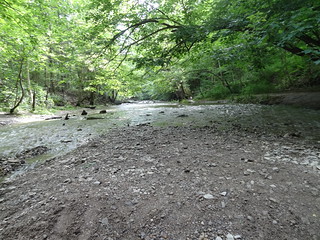
About an hour west of London we make one last stop at the Rock Glen Conservation area. This 10 hectare park is best known for two things; Rock Glen Falls and FOSSILS! There is even a little museum onsite, it closed just as we arrive….. We begin following a trail that leads us to a wooden stairway, we can already hear the rush of water from the falls, soon they come into view, at 10.7 metres (that’s about 35 feet to you and me) high, it is a stunning sight. Back up the stairs, we then follow a dirt trail that runs along the roadway, it leads us to another stairway in the woods. The conservation area is located in a transition zone, the Carolinian Forest Zone is to the south and the Great Lakes-St Lawrence Zone to the north, what that means is they have an amazing diversity of species from both zones; Sycamore, Black Walnut, and Tulip trees grow right alongside Sugar Maples, Beech and White Elm. Our walk through the forest is peaceful, the temperature is at least a few degrees cooler thanks to all of the trees. Ahead the stairway leads straight down, at the bottom a bridge leads across the shallow riverbed. It is here we pause to look for fossils, we walk a short distance into the woods, digging is not permitted, we see things that resemble fossils, but do not find any. Back on the bridge several samples lay out on the wood; brachiopods, crinoids and corals, they are all examples of extinct sea creatures that lived 350 million years ago–wow! This area is known worldwide for the Devonian era fossil deposits found here. They have done a great job providing trails, stairways and bridges that provide picturesque views of the area. Crossing the riverbed we are led back up to the top of the gorge and back to the parking lot, it is getting late and we still have a ferry to catch back to the US. It has been a wonderful few days in Ontario, we’ve had the pleasure of delicious food, friendly people, charming places and beautiful scenery–thanks Canada!

london 106

london 108london 116

london 126

fossilrama1

Saginaw

29 Jun

sag 127

After a peaceful nights sleep at the Webster House the car is loaded and we are on our way, a quick stop at Populace for coffee and we are headed to Saginaw. At one time Saginaw was a thriving lumber town, the nearby forests were thick with White Pine, the proximity to the river made it easy to float  logs down to the sawmills, they were then loaded onto ships and later railroad cars and sent all over the country. As lumber production began to disappear a new industry had taken hold of the area, manufacturing. Most of us are unaware at what a manufacturing hub Saginaw was, at one point the city and township were home to 12 General Motors plants and an Eaton manufacturing plant; not to mention the production of chemicals, plate glass and metal fabrication. Saginaw’s contribution to the Allies eventual victory was significant; facilities here produced over half a million M1 Carbine rifles for the US military along with gun parts, tank treads and ball screws for the Boeing B-29’s, thanks to our manufacturing base we could build it all! Through the years plants were bought and sold, many closed down, only a few continue to operate today. Saginaw struggles with the same issues so many of our once great manufacturing cities do. A trip down Jefferson Ave gives one a glimpse of Saginaw’s magnificent architecture.

sag 123

sag 119

sag 122

We begin our visit with a trip to the Marshall M Fredericks Sculpture Museum on the campus of Saginaw Valley State University, I bet you even know some of his work. Spirit of Detroit statue? Yep, that’s his, Christ On The Cross out in Indian River MI, that too, how about the Leaping Gazelle, aka the Levi L Barbour Memorial Fountain on Belle Isle? Uh huh, as a matter of fact, that was his very first commission. Fredericks grew up in Cleveland, graduated from the Cleveland School of Art in 1930, he traveled to Sweden to study under another great sculptor, Carl Milles (who had previously studied under Rodin in Paris). After Fredericks spent some time in Europe, he was invited by Milles to join him on staff at the Cranbrook Academy of Art in Bloomfield Hills, which he did, Fredericks resided in Birmingham MI until his death in 1998.

sag 095

sag 090

sag 089

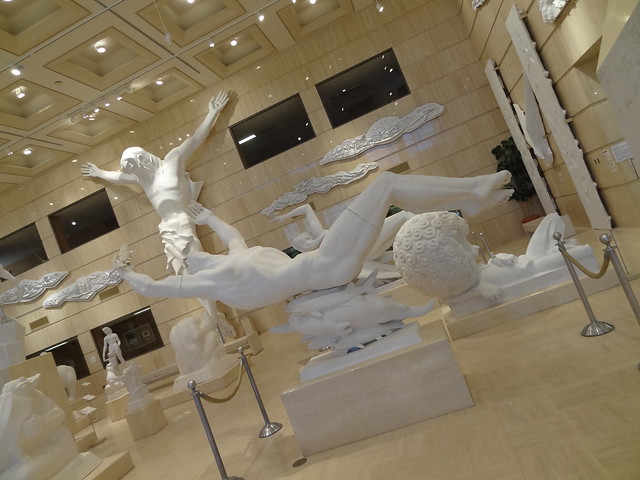
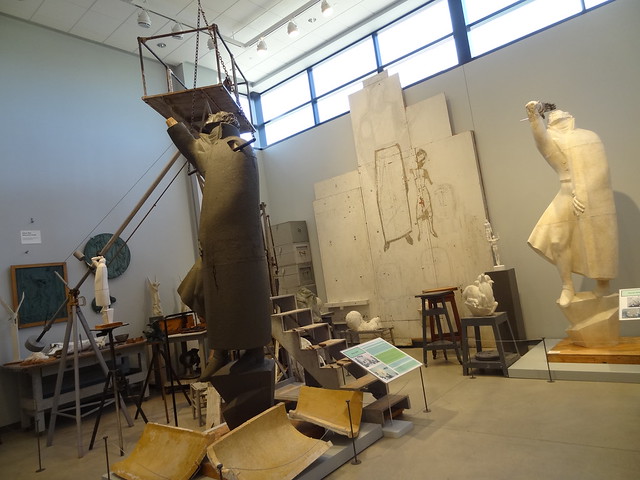
We arrive at the museum, Fredericks  sculptures are scattered about the landscape, Kris recognizes the Lion and the Mouse from his childhood days at Eastland Mall. Inside, a large space is tightly filled with plaster castings for Fredericks pieces, we are familiar with many of them. Starting at one side we take our time traversing the aisles; there are a couple of castings  for The Spirit Of Detroit in different sizes, it was not unusual for Fredericks to make smaller versions of sculptures as sort of practice pieces. A down-sized version of Christ on the Cross hangs on the marble wall, the Leaping Gazelle was one of his most reproduced pieces, it is lovely even in plaster. A row of elongated figures balance on round bases, they must belong to a fountain. The left wall is windows top to bottom overlooking a pretty green space, water splashes from one of Fredericks fountains. Figures are often reaching upwards towards a higher power, animals always look friendly, we recognize the Cleveland War Memorial Fountain. The next room over is a reproduction of Fredericks sculpture studio, everything in there; tools, equipment, armatures, came from his studios in Royal Oak and Birmingham. All the steps are laid out from sketch to casting, we watch a video showing the process, it really is amazing. The gallery displays 200 works of bronze and plaster molds that span Marshall Fredericks career, we both love his work! As we depart the museum we see the Night and Day Fountain, the same one sits outside the McMorran auditorium in Port Huron, we check out the remaining outdoor sculpture and then we are off to downtown Saginaw.

sag 101

sag 108

sag 111

As I mentioned earlier, Saginaw has some incredible architecture, one such building is the Castle Museum. Designed by William Martin Aiken it was built in 1898 as a United States Post Office, which means, no expense was spared. Completed in the French Renaissance Revival style, this place is stunning. Saginaw’s population continued to grow, in 1937 the building was enlarged, thirty years later the building was threatened with demolition, fortunately it was transferred to the County of Saginaw and became the Castle Museum of Saginaw County History. Covering all aspects of local history they have over 100,000 objects and artifacts related to the heritage of the area, they did a fantastic job making the museum interesting to everyone, not just locals. The interior space is perfect for a museum; wide hallways, large rooms, lots of windows, the structure itself is just as interesting as the exhibits. Automobiles from different eras are displayed in the main hallway, we see architectural pieces from old buildings, photos showing the interior when it was a post office hang on the walls. We climb the circular stairway to the top floor a gold medallion decorates the center of the ceiling. Exhibits take us from the early days when Indians roamed the land to the time of lumbering, noting that in 1880 Saginaw Valley was home to 80 sawmills. My favorite section is the re-creation of Saginaw in its prime; a vegetable truck sits near the City Market, you can pretend you are taking a ride on a street car downtown. When Myer Bros. Jewelers closed in 1974 the museum obtained all of the interior counters, cabinets and mirrors, I actually feel like I am in the store, it’s beautiful! Other local shops are represented as well including Morely Bros. Hardware.

sag 071

sag 005

sag 018

 Back in the days when the building was a post office people actually paid their bills by sending cash in the mail….In one area we see the old safe, signs direct us up a narrow stairway, leading to an even narrower hall, from here we see tiny elongated windows that were used to ‘spy’ on employees as they were processing the mail, the government wanted to make sure all that cash got to its intended destination. The lower level is home to a large “HO” Scale operating railroad with more than 1000 feet of track, two freight-yards and realistic vintage scenery. Maintained and operated by the Saginaw Area Module Modelers it’s really cool. We walk the perimeter of the large display, there is so much to take in, trains are running in several different directions, volunteers are happy to explain all that we are seeing. Throughout the museum we see much of Saginaw’s history from furniture, photos and clothing to vehicles, toys and household goods, it has been an enjoyable visit.

sag 064

sag 059

sag 042

As we exit the museum our gaze falls upon another gorgeous building right behind it, this would be the Hoyt Public Library. Although Jesse Hoyt was never a permanent resident of Saginaw he and his family owned a substantial portion of the city and were involved financially in lumber, railroads, salt and buildings. Always concerned for the welfare of the community, he willed the city $100,000 for the establishment of a public library to be built on a parcel of land owned by him. The library was to be for consultation and reference only and to always bear the name Hoyt Public Library, completed in Romanesque design the library opened in 1890. We were so happy when we pulled on the door and it opened, we step inside and pause to look around, it is quite lovely. Kris begins to take photos as I wander about. A couple of employees engage us in conversation, we tell them we are fond of old buildings, they smile and tell us to have a look around. One man acts as our guide and takes us from room to room, I’m always excited when the big key ring comes out and we get to see spaces not generally open to the public. There is lots of wood and ornate plaster, a fireplace takes center stage in one of the small rooms. Completely renovated in 1997, new lighting was hung, old wooden shelves were replaced and computers were installed all the while maintaining the original Victorian motif. If you’re ever in town be sure to stop in and have a look around.

sag 074

sag 077

sag 085

It is late afternoon and we have yet to have lunch, we are starving! We take a drive through downtown but have no luck finding anything open on a Saturday. We cross the river  and scan the area for somewhere to eat; in no time we find ourselves at the Old Town Drive-In. This charming old-fashioned car-hop restaurant has been serving up their homemade draft rootbeer, rootbeer floats and coney dogs since 1940. The outdoor spaces are filled, so we decide to eat inside, a row of swivel bar stools line the counter, we have a seat and quickly decide what to order. Before we know it our food arrives; a coney dog, a cheeseburger and fries. We always like to try out the coney dogs at these cute family owned drive-ins, each has its own distinct coney sauce. Everything is good, we polish off the meal quickly.

sag 131

2

We make one last stop in town at the Saginaw Art Museum on Michigan Ave. The museum is housed in the former Ring family residence, built in the early 1900’s in the Georgian Revival style, the family donated the home to the city. There is a buzz of activity when we arrive, a wedding is about to take place in the formal gardens. Inside we are slightly disappointed to find artwork removed and areas closed off, but the place is wonderful all the same. My favorite space is the former dining room, rich Butternut paneling adorns the walls giving the room a cozy feel. We proceed through the galleries, the collection contains about 1700 pieces, American and European art being the majority of the collection. There is a nice variety on display today; paintings, sculptures, textiles and African art. One area of the modern and contemporary is filled with folding chairs this afternoon, ah, the wedding. The museum is currently closed for renovations and will re-open in the Fall, we look forward to a return visit when we will be able to see it in its entirety. We have thoroughly enjoyed our visit to Bay City and Saginaw, there was so much more than we expected to find.

sag 143sag 140

sag 145

sag 137

Bay City: Part II

23 Jun

1

On our way to the bed and breakfast, we take a detour along the Saginaw River in search of the permanent mooring site of the USS Edson. I read that the destroyer had arrived in Bay City and was to open as the Saginaw Valley Naval Ship Museum in May. We continue to follow the river, just as we are about to give up, the enormous ship comes into view; at an overall length of 418 ft, it is quite a sight. A trailer sits off to the side, it’s early evening, we hope there’s still time to get a tour. Inside we are greeted warmly by volunteers, told we can start our tour immediately, we pay the admission and we are off. As we approach the destroyer I am taken aback by its size, our guide  is knowledgeable and friendly, he rattles off facts and figures effortlessly, here are a few; the USS Edson  is a Forrest Sherman-Class destroyer, 45 ft beam, 22 ft draught, 418 ft overall length. Commissioned in 1958, earned a reputation as a Top Gun ship, nicknamed “The Destroyer” and “The Grey Ghost of the Vietnamese Coast” as a member of the US Pacific Fleet, decommissioned in 1988.

baycity 202

baycity 189baycity 175

We go inside the ship, everything is painted the same shade of grey, hallways are narrow, the low ceiling is thick with wiring. We peek inside a series of different rooms, in some, walls are covered in nautical charts, in others bunks hang from chains and are stacked three high, officers had it better, one bed and their own bathroom. Everywhere I look I see switches, dials, gauges and knobs. As we walk our guide tells us stories about the Edson and the men who temporarily called the ship home. They had everything they needed; a barbershop, doctor, dentist, they could buy a candy bar and mail letters. We enter the galley area, there are maybe a dozen booths where the men would take their meals, with a crew of 17 officers and 218 men, they had to eat in shifts. We go down to the engine room where the 70,000 horsepower Worthington steam turbines are located, these monsters are capable of powering this massive ship to nearly 50 miles per hour, Wow, can’t imagine how loud it must have been down there, not to mention the heat. The pilot house is huge, we peer out the windshield at the Saginaw River, passing boats blow their horns and passengers wave as they pass. The Saginaw valley was home to many shipyards, the former Defoe Shipbuilding Company built many ships for the US Navy, making Bay City a perfect home for the USS Edson.

baycity 151baycity 173

baycity 162

baycity 181 (1)

We make our way back downtown to Populace Cafe on Washington Ave, time for a coffee break. Opened in 2012 the original owner ran the cafe, the wholesale business and most importantly roasted all the coffee. Though he still owns and runs Populace Coffee Company he sold the cafe to his barista, Lindsay, and the place is thriving. The decor is an eclectic mix of vintage and modern, chalkboard menus hang on the wall in pretty vintage frames. They have the usual espresso and coffee drinks you’d expect to find, but what really sets the shop apart are Lindsay’s homemade syrups; vanilla, dark chocolate and 3, yes I said 3, kinds of caramel! Kris had an iced coffee with the vanilla and loved it, unable to decide between the dark chocolate and the salty caramel, she made me a latte with both, yum! They also have a nice selection of teas and some tasty looking baked goods. Heck, we’d come to Bay City just for the coffee!

baycity 142

baycity 140

At last we arrive at the Historic Webster House where we will be spending the night; built by Judge Thomas Webster in 1886 the 4,750 sq. ft. home is a lovely example of Queen Anne architecture. We are immediately greeted by innkeepers Frank and Gail, we walk through to the breakfast room where Frank points out a batch of freshly baked peanut butter chocolate chip cookies. The home is gorgeous; stained glass windows, polished hardwood floors, ornately carved wood trim and moldings, it is completely furnished in Victorian period pieces. Gail leads us to the stairway, she pauses at a table holding a platter of cheese and crackers, I catch the fragrance of red wine before I see the decanter and matching glasses, I love this place already! We ascend the steps up to the second floor where a guest refrigerator is stocked with soft drinks and more wine, Gail takes us into our room, it is splendid. The room is distinctly shaped, one wall is a series of large windows; a small table and two chairs are placed against a window. The bed is higher than a standard bed, the blanket is fluffed, it looks extremely comfortable. We have a fireplace and a small flat screen TV, the bathroom is roomy, I wish we were staying all weekend…… We help ourselves to a glass of wine, unpack a few things and get ourselves situated. If you’re looking for some luxe accommodations in Bay City, give this place a try!

baycity 205

baycity 288

baycity 215

The Webster House is located in the Center Avenue Historic District, in 2011 the district was expanded to include 875 structures in a variety of styles from Gothic Revival and Italianate to Richardson Romanesque and Arts and Crafts. As we walk we pass grand manor homes, keep in mind this neighborhood was where industrialists, lumbermen and ship builders dwelled.  It is a perfect evening; water splashes in concrete fountains, Irises are blooming, lilacs perfume the air. The grass is deep green and lush, long walks lead to front porches bearing cement lions or gargoyles. Huge urns filled with annuals add a splash of color, ivy climbs the fireplace of a stately Tudor. There are also a number of “kit homes”, the Alladin and Lewis & Liberty Companies pioneered the manufacture of kit homes right here in Bay City. We arrive at a quaint little park; in a pond, water streams up from a whale and a dolphin, they look as though they have been entertaining children for decades. We take Center Street back to the bed and breakfast, have to freshen up for dinner.

baycity 234

baycity 222baycity 219

baycity 240

baycity 239

baycity 218

Everybody we talk to in Bay City tells us to have dinner at Old City Hall; as you may have guessed the building, opened in the late 1890’s was the city’s first city hall. Back in the logging days this area was known as “Hell’s Half Mile” for all of the rough activities that took place in the local saloons and brothels that stretched this section of road, eventually it forced the relocation on city hall. Today the restaurant looks like something you’d find in Birmingham or Ferndale, exposed brick walls, funky light fixtures made from empty wine and liquor bottles and a diverse menu. We begin our meal with the Thai lettuce wraps, a tasty blend of chicken, cashews and veggies smothered in a mild Thai sauce spooned into crisp romaine lettuce leaves, delicious. Our entrée of shrimp pad Thai arrived in a large bowl and smelled wonderful. A combination of shrimp, tofu, bean sprouts, egg and crushed peanuts the sauce was sweet and spicy, scrumptious.

baycity 269

baycity 259

After dinner we walk down to the water front, the temperature has dropped quickly, we can see our breath when we speak, ah, Michigan in May! Lights across the river reflect on the still waters, pretty, a large white sculpture lights up Wenonah Park, the Delta College Planetarium looks super cool at night. The cold night air sends us back to the bar at Old City Hall; with 150 wines from around the globe and 23 beers on tap there is much to choose from. We sip our drinks and relax, it has been a fun and busy day.